A Little Door, a Little Lie: The Candlelit Advent Mystery Calendar
Advent calendars have spent decades offering a tiny square of chocolate and a vague sense of superiority over people who bought theirs in September. In 2026, why not add a body? Not an actual body. This is a cosy whodunit, not a documentary about the Christmas post. Instead, turn the calendar into a progressive mystery: one door, one clue, one suspect, one candlelit moment each evening until Christmas Eve, when the last door opens and everyone points accusingly at the person who brought the nice biscuits.
Why Advent suits a slow-burn mystery
A murder mystery night is usually a sprint: gather the suspects, hand out the scripts, and hope nobody notices that the vicar is reading their lines off a napkin. An Advent calendar is the opposite. It gives you twenty-four tiny episodes, each short enough to fit between tea and the telly, and each ending on just enough of a hook to make tomorrow feel intriguing. Advent Sunday falls on 29 November in 2026, so by the time December arrives you can have the whole thing ready, sealed, and looking suspiciously organised.
The format also solves the December problem. Nobody has the energy for a three-hour immersive event on a Tuesday when the boiler is making that noise again. Ten or fifteen minutes around a battery candle is achievable. It is also repeatable, which means children, grandparents, flatmates, and the neighbour who keeps dropping round for mince pies can all take part without anyone needing to learn a monologue.
The plot: something has gone missing in Little Mistletoe
For a bloodless mystery, you need a crime with low stakes and high gossip value. The Golden Star of Little Mistletoe has vanished from the village hall the night before the lights switch-on. It is not a priceless heirloom. It is a slightly wonky cardboard star covered in last year's glitter, and the village is taking it personally.
Your suspects can be assembled from familiar festive types: the retired headteacher who has opinions about the raffle, the competitive carol singer with a suspiciously good memory for alibis, the cousin who brings Tupperware to every gathering, the neighbour who insists they are not competitive about exterior illumination, and the dog, who is almost certainly innocent but has the sort of face that invites suspicion. Nobody is actually murdered. The victim is the village's festive pride, which has been gravely wounded and will require a strongly worded notice on the parish board.
Build the calendar: doors, clues, and printable cards
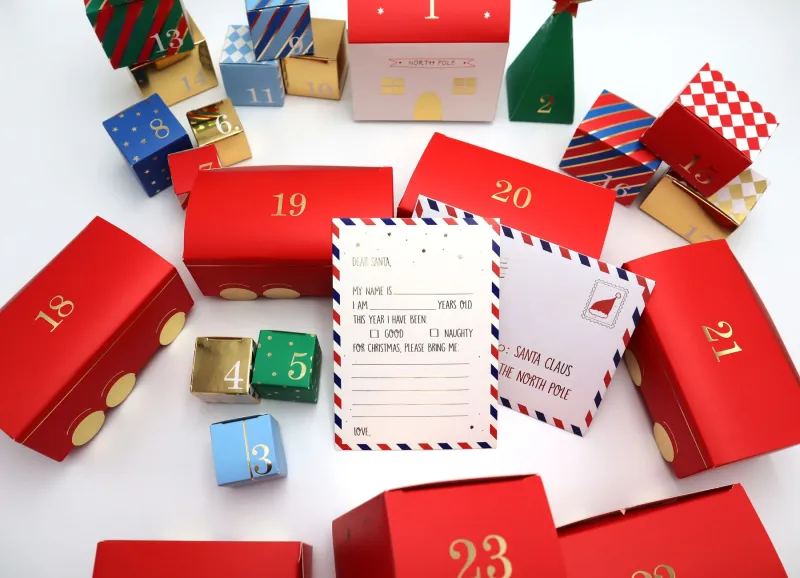
You can use an existing Advent calendar, but a homemade one gives you more control and a satisfying amount of fiddly craft. Number twenty-four envelopes or small boxes from 1 to 24. Inside each, place a printable clue card, a small prop, or a suspect introduction. A6 cards work well: big enough for a readable clue, small enough to fold into an envelope without a fight.
A simple structure keeps the pacing honest:
- Doors 1 to 3: introduce the missing star, the setting, and the main suspects.
- Doors 4 to 18: one clue or one suspect each evening, with a mix of physical evidence, overheard remarks, and mildly suspicious Christmas behaviour.
- Doors 19 to 22: red herrings, alibis that do not quite fit, and one clue that looks important but is mostly there to make everyone accuse the dog.
- Door 23: the final nudge. Something that makes the Christmas Eve denouement feel earned rather than conjured from nowhere.
- Door 24: not another clue, but an invitation. Gather the suspects, light the candles, and reveal.
Print a master solution and seal it in an envelope marked with something stern, such as DO NOT OPEN UNTIL CHRISTMAS EVE, OR UNTIL AUNTIE JEAN GETS TOO CONFIDENT. Keep a spare set of clue cards. December has a way of involving spilled mulled apple juice.
Pacing for busy households
Real households miss nights. There will be a school nativity, a late shift, a parcel that needs collecting, and an evening when everyone simply forgets. Build in an amnesty. If you miss a door, open two the next night and call it a double bill. Nobody needs to feel behind on a mystery they are meant to be enjoying.
Keep each evening to one short ritual: light the candle, open the door, read the card, let everyone make one accusation, then stop. Resist the urge to explain too much. The pleasure is in the accumulation. A clue that seems meaningless on 4 December should feel quietly brilliant on 21 December, like finding a stray chocolate behind the sofa.
If you are hosting, send the printable cards in advance and keep the solution to yourself. If you are doing it with family, give the calendar keeper a notebook. A small notebook makes the whole thing feel official and gives the quieter sleuths somewhere to put their theories before the louder ones steamroll them.
Keeping it bloodless for mixed-age groups
This is where the cosy part earns its keep. No gore, no real weapons, no lingering trauma, and no motive that requires a family conference afterwards. The culprit has done something petty, festive, and entirely reversible: hiding the star because the lights committee ignored their suggestion about a gingerbread theme. The consequence is not a prison sentence. It is having to do the washing-up on Boxing Day and apologise to the village hall committee in writing.
Children can be deputy sleuths. Older relatives can be suspects with excellent alibis and poor hearing. Teenagers can be invited to design the clue cards and then pretend they are not enjoying it. Use alcohol-free mulled apple juice, keep the lights low, and let the mystery be gentle enough that nobody has nightmares about tinsel.
Candlelight, but sensible
Candlelit suspense is the brand, but paper clue cards and open flames are not a partnership to encourage. Battery tealights in little glass jars give you the flicker without the fire risk. If you do use real candles, keep them well away from envelopes, ribbons, cards, and anyone who has had three brandies and a strong opinion about the culprit. One candle per evening is plenty. The point is atmosphere, not a re-enactment of the Great Fire of Little Mistletoe.
The Christmas Eve denouement
Door 24 should feel like the last page of a paperback: all suspects assembled, one obvious question, and a satisfying click. Gather in the most candlelit room you have, read the final invitation aloud, and ask each suspect for their alibi. Let everyone make one last accusation. Then open the solution envelope slowly, because theatre matters.
Reveal the culprit, explain the clues, and give the guilty party a chance to confess with dignity and a plate of something from the tin. The last door opening should feel like the whole month folding into one neat moment. If you have done it well, someone will say they suspected it all along. They did not. That is the sign of a successful whodunit.
And if the mystery goes slightly wrong, blame the dog. Then reveal the dog was asleep. Then blame the cousin with the Tupperware. It is Christmas. Forgiveness is traditional.