No Arson in the Drawing Room: A Candle-Safety Field Guide for Amateur Sleuths
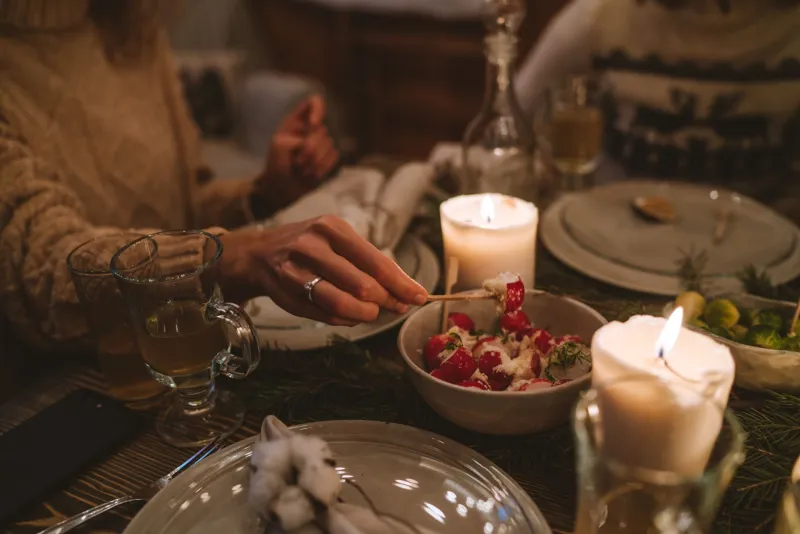
Photo: candlelit murder mystery party table with clue cards and candles, via www.felineliving.net
There is a fine line between candlelit suspense and an insurance claim, and it is usually marked by a tea light too close to a paper clue. A murder-mystery night needs shadows, flicker and the sense that something wicked this way comes. It does not need the fire brigade. The good news is that real candles can absolutely stay in the production — provided you treat them like a suspect with a motive.
Real flames, real responsibility
LED candles have improved enormously. Some even flicker with a convincing little sulk. But a room full of rechargeable faux flames can feel like a department-store window display rather than a seance gone wrong. My advice is to use real candles where you can see them at all times, and LED everywhere else: hallways, entrances, costume accessories, stairs and any spot where guests will move quickly while wearing something swooshy.
The working rule is simple. Real flame is for tabletop theatre. LED is for thoroughfare and foolish hats.
Where candles should never go
Clue cards are the obvious danger. Paper curls, edges singe and before you know it the crucial alibi is a small pile of ash. Keep flames at least a forearm's length from clue cards, envelopes, newspapers, maps and anything with a decorative fringe. Stable holders with wide bases are non-negotiable. A candle that can be knocked over by a sleeve is not atmosphere; it is a plot device you did not plan.
Avoid shelves, windowsills, the floor, the space under pinboards, and anywhere near curtains or bunting. Draughts are the enemy. So are pets, children and the guest who has decided to demonstrate a dramatic exit. The cat is not a co-host. The cat is a liability with whiskers.
Costumes: tulle is not a wick
Period drama costumes and murder-mystery nights go together like Poirot and a neatly trimmed moustache. Unfortunately, so do tulle, net, feather boas, synthetic wigs and fake fur. If a guest's sleeve could sweep a table, move the candle before they arrive. Create a costume-safe zone near the entrance where LED candles do the moody work, and keep real flames confined to the dining table or a supervised sideboard.
A useful host habit: walk the room once while wearing your most voluminous coat. If you brush a candle, so will someone else.
Scent, ventilation and the humble sash window
Scented candles are lovely in theory. In practice, six of them in a small sitting room will give everyone a headache and make the sausage rolls taste of vanilla and regret. Use unscented candles near food, and keep one gently scented candle in the hallway if you want that arriving-at-a-country-house feeling. Ask guests about asthma, migraines and allergies before you fill the room with perfume.
Ventilation matters, especially in a pub function room or a village hall that has been holding its breath since 1974. Open a sash window or a fire door between scenes, but do not create a cross-draught through a room full of flames. Air the room, then close it down, then relight.
Dimming between scenes without a disaster
Do not blow candles out. Blowing sends hot wax and sparks in directions that no director intended. Use a candle snuffer, or invert a metal spoon carefully if you are being resourceful. Dim in stages: turn off the electric lights first, then snuff one candle at a time. Keep a torch or phone light nearby for reading clue cards, and never leave a room with candles still burning and no adult watching them.
If you are using LED candles for scene changes, check the remote before the night begins. There is nothing less atmospheric than a host crouching behind a sofa saying, 'It should be on the green setting'.
The UK host's pre-flight checklist
- Check the venue rules first. Landlords, village hall committees and caretakers all have opinions, and some have extinguisher policies.
- Test smoke alarms. Know where the exits are. Keep a fire blanket and a suitable extinguisher within reach.
- Use stable, heatproof holders and mats. No candles directly on polished tables, tablecloths or paper.
- Trim wicks to about 5mm. Do not let a candle burn right down inside its holder.
- Keep flames away from paper, cloth, costumes, alcohol and anything that flutters.
- Appoint one responsible adult as candle marshal. It should not be the murderer, who will be busy being shifty.
- Have a torch, a snuffer and a damp tea towel or fire blanket to hand.
- Ask about allergies and breathing issues before you go scent-heavy.
- In a village hall, read the risk assessment and do not hang bunting above naked flames. This feels obvious. It is not always obvious.
The final snuff
At the end of the night, snuff rather than blow, ventilate the room, and check under tables for forgotten tea lights. Do not tidy away clue cards until every flame is out and every holder is cool. The best compliment a host can receive is not 'that was realistic' but 'that felt dangerous in a lovely way'. Aim for the lovely kind. Keep the fire brigade for the story, not the street outside.